

Free Resource · June 2026
The Capability Transfer Diagnostic
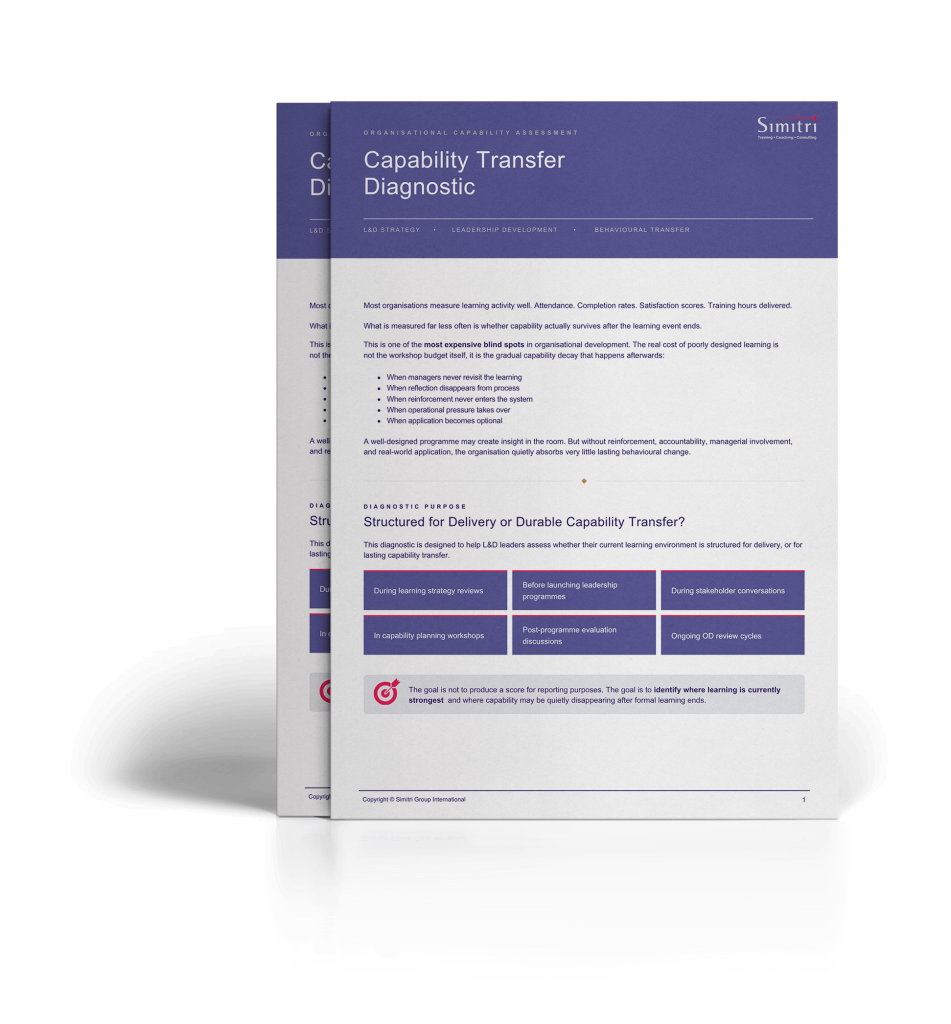
A self-assessment tool for L&D leaders to identify where learning survives and where it quietly disappears after formal programmes end.
2 pages · PDF · 10 Statements
“The hidden cost most organisations fail to measure is not training spend, it is capability decay after the learning event ends.”— Simitri Insights Team
WHY THIS MATTER
Organisations measure learning activity. They rarely measure capability survival.
Attendance, completion rates, satisfaction scores these tell you what was delivered. They tell you nothing about whether the capability is still visible three months later. This diagnostic surfaces the blind spot most L&D strategies quietly ignore.
Capability decay is the real cost of poorly designed learning
When managers never revisit the learning, reflection disappears, and operational pressure takes over, the organisation absorbs very little lasting behavioural change regardless of programme quality.
The gap between delivery and transfer is rarely visible
Most organisations don’t know whether their learning environment is structured for sustained capability transfer because they’ve never asked the question in a structured way. This diagnostic makes it visible.
Without reinforcement in the system, application becomes optional
A well-designed programme creates insight in the room. Without accountability, managerial involvement, and real-world application built into the environment, that insight quietly disappears.
WHAT YOU’LL GET
A ten-statement diagnostic you can complete in under ten minutes.
10 Diagnostic Statements
Score each statement from 1 to 5 based on how strongly it reflects your current learning environment from manager reinforcement and peer accountability to reflection opportunities and business linkage.
A Clear Scoring Guide
Three score bands, each with a plain-language interpretation, reveal whether learning is embedded in operational reality, reliant on individual motivation, or operating primarily as a one-off event.
Six Contexts for Use
Purpose-built for learning strategy reviews, capability planning workshops, pre-programme launches, post-programme evaluations, stakeholder conversations, and ongoing OD review cycles.
A Conversation Starter, Not a Report
The goal isn’t a score for reporting purposes, it’s identifying where learning is strongest and where capability may be quietly disappearing after formal learning ends.
RELATED RESOURCES
Planning Framework – Free download
The Capability
Prioritisation Toolkit
A practical framework for identifying where capability gaps are most affecting organisational performance and focusing development investment where it matters most.
Guide – Free download
The Learning Transfer
Readiness Guide
Assess the organisational conditions that determine whether capability development sticks and identify the structures and behaviours that quietly weaken transfer before a programme begins.
June 2026 · Simitri Insight
You Don’t Have Time.
How Do You Still Develop Your People?
This diagnostic is part of our June 2026 Insight, where we explore how L&D leaders can design meaningful development into the realities of a pressured, time-poor organisation without waiting for perfect conditions.