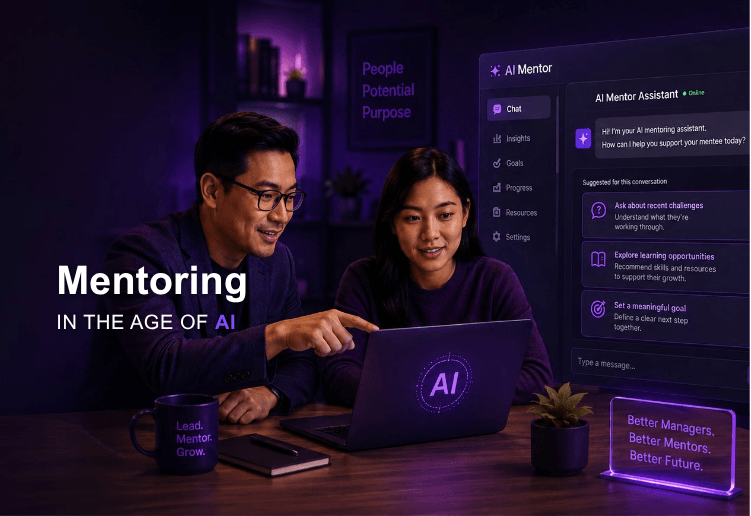
An old practice. Powerful new tools.
Ask someone who taught them the most about doing their job well.
Chances are, they’ll remember a respected and seasoned individual who took them under their wing.
Someone who let them watch. Then try. Who shared what experience had taught them, who saw something they couldn’t yet see themselves.
We’ve called this many things.
Mentoring. Coaching. Peer Learning. On the Job Training.
Different forms. One enduring principle: We learn differently when we learn with and from other people.
Some of the ways we learn from others are changing.
Much of our development happens in moments nobody calls “learning.”
Watching someone more experienced. Asking, “Can you take a look at this?” Trying first, then getting feedback. Seeing how someone else handles a difficult situation.
Today, AI can draft the first version, find the answer, summarise the meeting and suggest what to say next.
It makes us faster and more independent. But sometimes, it also lets us skip the steps we once learned through.
AI removes some rungs, perhaps we should also ask how it can help us build new ones.
By helping us prepare, practise, notice and reflect, and see things we might otherwise miss.
The Evidence
What we do with that insight is where development begins.
In our work with clients, we see the same principle: insight alone rarely changes behaviour. The opportunity lies in what happens next: in conversation, in practice, and in the continued application.
What if we could bring more into the mentoring conversation?
A mentoring conversation might happen once a month. Development happens every day in between.
A difficult meeting. Feedback that didn’t land. A conversation that went surprisingly well. An approach worth trying again.
Most of those moments fade before the next mentoring conversation happens. What if an AI tool can give us new ways to capture, practice and reflect on our conversations while they are still fresh and help us build a framework to make these conversations better after every opportunity?
IMD research explored AI analysing executive communication against best practice frameworks and providing personalised feedback. The value is not simply the feedback; it is having something specific to explore.
AI might identify: “That you moved quickly from listening to offering solutions, when there was an opportunity for you to ask questions to simulate self reflection.” A mentor could have asked: “What made you step in at that moment? What might have happened if you had stayed with the question?”
“AI makes it visible. Human interaction makes it meaningful.”
— Simitri GroupEnsure the value of a good 1-to-1 carries into the next.
A workflow documented by The Rundown shows how AI can create continuity across manager 1-to-1s: connecting previous conversations, commitments and recurring themes.
Instead of relying on memory, managers can surface what matters: What keeps coming up? What was agreed? What has changed? What needs attention next?
Each conversation becomes context for the next.
“The opportunity isn’t simply to remember more. It’s to make every conversation build on the last.”
— Simitri GroupAI is already part of how we work. The question is how we use it.
- Its value doesn’t have to stop at: Do this for me.
- It can also help us ask: What can I learn from this?
- Why did one conversation work better?
- What pattern am I missing?
- What could I practise before next time?
- What should I bring to my mentor?
“Don’t just use AI to do more. Use it to get better.”
— Simitri GroupFor mentoring, that means richer reflection, more deliberate practice—and better questions when two people sit down together.
AI is already part of how we work. The question is how we use it.
Technology gives us new tools. The fundamentals of development remain remarkably consistent: Experience. Practice. Feedback. Reflection.
“Don’t just use AI to do more. Use it to get better.”
— Simitri GroupWhat Changes: Mentoring, Designed for Today
Start With What Matters
Avoid vague goals like “be a better leader.” Be specific: feedback, delegation, influence, coaching, difficult conversations. Give mentoring somewhere to go.
Pair With Intent
The best mentor isn’t necessarily the most senior. Match for relevant experience and the ability to help someone think. Experience matters. So does the ability to unlock someone else’s.
Bring the Real Work
The meeting that went wrong. The conversation that went surprisingly well. The decision you would make differently. Real work gives mentoring something real to work on.
Use the Tools Around the Conversation
Prepare better. Practise more. Capture reflection. Notice patterns. Bring better questions. Don’t ask AI for a verdict. Use it to find better questions.
Turn Insight Into Another Try
A good mentoring conversation should end with: “What will you try differently?” Try it. Notice. Reflect. Adjust. Try again.
Experience → Notice → Reflect → Mentor → Try Again ↻
That’s how mentoring becomes more than a conversation. It becomes a learning loop.
New possibilities also require thoughtful boundaries.
Privacy. Consent. Trust. Context. Not everything that can be analysed should be.
Development should help people see. Not make them feel watched.
Use technology to bring something useful into the conversation, not to turn every interaction into a score.
AI is already changing what we can do.
The bigger opportunity may be asking:
What can AI help me become better at?
Some of its greatest value may come not from doing more for us, but from helping us learn more from what we do.
And that creates powerful new possibilities for how we learn from one another.
At Simitri, we help organisations turn mentoring into meaningful development: defining what matters, equipping mentors for better conversations, connecting development to real work, and creating practical frameworks that turn insight into action.
What could mentoring look like in your organisation if it were designed for how people work today?
Let’s explore it together.
Better mentoring is designed, not left to chance.
Get in touch