
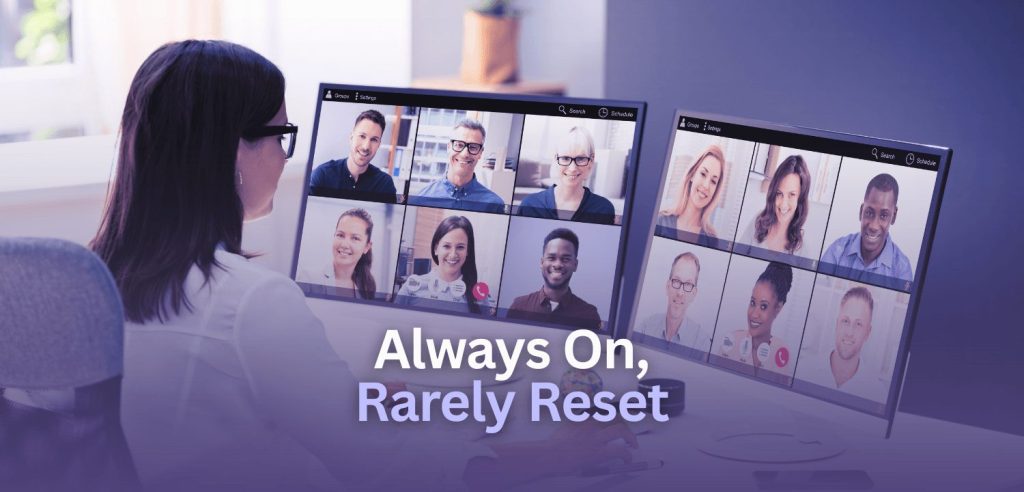
Even in today’s flexible, tech-enabled workplaces, many people feel drained, not because of a lack of skill or effort, but because of the constant digital noise and the relentless pace of modern life. For leaders, this creates a new challenge: how do we sustain energy, not just output in ourselves and in our teams?
01 The challenge
The Invisible Load Most Leaders Miss
Alongside professional and personal demands, people are also processing global events, endless notifications, and constant scrolling. Even outside work hours, the mind rarely has the chance to pause and recover.
It’s no surprise, then, that people often show up to work already carrying a lot of tension. This creates an opportunity to rethink how work is designed, how leadership shows up, and how organisations create environments where people can sustain energy, not just output.

Even in today’s flexible, tech-enabled workplaces, many people feel drained, not because of a lack of skill or effort, but because of the constant digital noise and the relentless pace of modern life. For leaders, this creates a new challenge: how do we sustain energy, not just output in ourselves and in our teams?
02 A framework for energy
Creating the Right Conditions for People
Rather than asking, how people can meet those stretched objectives, forward-thinking organisations are asking:
How can we build the environment for people to feel clear, capable, and open to doing their best work?
Creating space for energy to thrive at work is not accidental. It is shaped by systems, culture, and everyday experiences.
In many organisations, performance issues are often energy issues in disguise. When people have the space to think, reflect, and engage meaningfully, the quality of their work naturally improves. Creativity increases, decision-making becomes sharper, and collaboration feels more intentional rather than reactive.
Three Conditions That Sustain Performance
Space to think
Uninterrupted time for reflection and deep, focused work
Space to connect
Relationships built on trust and genuine human interaction
Space to grow
Development that feels relevant, purposeful, and connected to real work
03 Learning as an energiser
Learning & Development as an Energiser

Learning is often seen as another time-consuming task on an already full schedule. But when designed intentionally, it can become something far more powerful.
It could become a welcome pause in the noise, an opportunity to reset.
The best learning experiences create space to think, reflect, and engage in meaningful conversations. They create time for growth, reconnect people with purpose, and help them engage more deeply in skill-building and behaviour change. Importantly, learning also creates shared experiences. In a world where work can often feel fragmented and individual, these shared moments bring people back into collective thinking. They allow teams to align, exchange perspectives, and build stronger connections.
When this happens, learning restores energy and motivation.
04 Organisational practice
What Leading Organisations Are Doing
Across sectors, we continue to see a consistent pattern: sustainable performance improves when organisations redesign everyday experiences of work, not just strategy decks or annual programmes.
The strongest examples are rarely dramatic. They are deliberate, consistent, and well-designed.

CASE STUDY: SLACK
Making recovery part of performance
Slack’s Workforce Lab explored a challenge many organisations recognise: people were technically working, but not always working well. Constant activity was being mistaken for effectiveness. Rather than treating breaks as personal preference, Slack helped make recovery visible and normalised. Leaders encouraged employees to step away during the day, internal prompts reinforced the behaviour, and rest became part of how work was discussed. The results included stronger productivity, improved wellbeing, and better focus.

CASE STUDY: MICROSOFT
Embedding learning into real work
Microsoft’s use of peer coaching and learning circles reflects a shift many organisations are now making: learning is most powerful when it happens in the context of real work, not apart from it.
Small groups came together regularly to discuss live challenges, exchange perspectives, and support one another in applying ideas. This moved learning beyond content consumption into practical capability-building. The programme reported high satisfaction and stronger collaboration across teams.
Leadership Lesson:
People learn fastest
when growth is connected to real work.
Source: Authenticity Consulting (Microsoft Learning Circles Case Study)

CASE STUDY: CISCO
Listening as a leadership capability
Cisco introduced regular engagement pulse check-ins to hear employee feedback more frequently and respond faster. This was more than a survey mechanism. It signalled that listening was not an annual event, it was an ongoing leadership responsibility.
Employees reported feeling more heard, with positive impact on engagement and retention.
Leadership Lesson:
People trust feedback systems
when they lead to visible action.
Source: Cisco Employee Pulse Survey & Engagement Practices
What connects these examples is not industry or geography. It is a shared understanding that behaviour, leadership habits, and day-to-day culture directly shape results.
For organisations navigating growth, change, or capability gaps, the question is rarely whether people matter. It is whether leaders are equipped tolay the groundwork for people perform at their best.
05 Practical leadership
What Can Leaders Do, Practically?
The most meaningful changes rarely come from complex framework overhauls. They come from consistent everyday actions and behaviours.
Leaders who take time to be visible, whether by walking the floor or informally checking in online, strengthen trust within their teams. Conversations that go beyond tasks where people feel valued, build trust and openness.
Something as simple as taking team members out for a walk, coffee or lunch can shift the quality of interaction entirely. These moments allow people to relax, speak freely, and feel genuinely seen.
Creating space to pause within the workday also plays a critical role. Reducing unnecessary meetings, allowing short breaks between discussions, and simplifying communication can significantly improve capacity to think and re-prioritise.
Equally important is what leaders model. When they demonstrate boundaries, prioritise presence, and actively engage in learning moments, it signals to teams that sustainable ways of working are not just encouraged, they are expected.
Over time, these behaviours shape culture far more than policies ever can.
01
Be visible
Walk the floor or check in informally online. Conversations that go beyond tasks build trust and openness that no policy can replicate.
02
Create pauses
Reduce unnecessary meetings. Allow short breaks between discussions. Small structural changes significantly improve people’s capacity to think.
03
Model boundaries
When leaders demonstrate boundaries and engage in learning moments, it signals to teams that sustainable ways of working are expected, not just encouraged.
04
Invest in connection
A walk, coffee, or lunch can shift the quality of interaction entirely. These moments allow people to relax, speak freely, and feel genuinely seen.
Small Actions, Real Impact
Across organisations, we’re seeing a consistent pattern.
Short learning moments, reflective team huddles, peer conversations, and informal knowledge-sharing spaces are helping people reconnect with colleagues and work. These are not large interventions, yet they create space for collaboration, reflection, and deeper thinking.
People feel a stronger sense of belonging and support, which becomes a powerful source of motivation. And that’s where real energy comes from.
06 Further perspectives
Learn from Others, Leadership in Action
For leaders looking to explore these ideas further, here are a few powerful talks and examples that bring this to life:
Leadership practices inspired by companies like Atlassian
Known for introducing “no-meeting” or focus days to help teams create uninterrupted time for deep work and improve overall productivity and wellbeing.
Closing Thought
Work rarely feels lighter because demands disappear. It feels lighter when leaders reduce friction, restore clarity, and design work around how people actually perform.
When we enable people to think, connect, and learn in meaningful ways, they show up with greater clarity, focus, and energy.
Often, it is not the dramatic changes that matter most, but the small, consistent actions that shape how people experience work every day.
07 Practical Leadership Tools
Four Tools for Everyday Use
Below are a few Practical Leadership Tools for leaders to explore, reflect on, and bring into their everyday interactions.